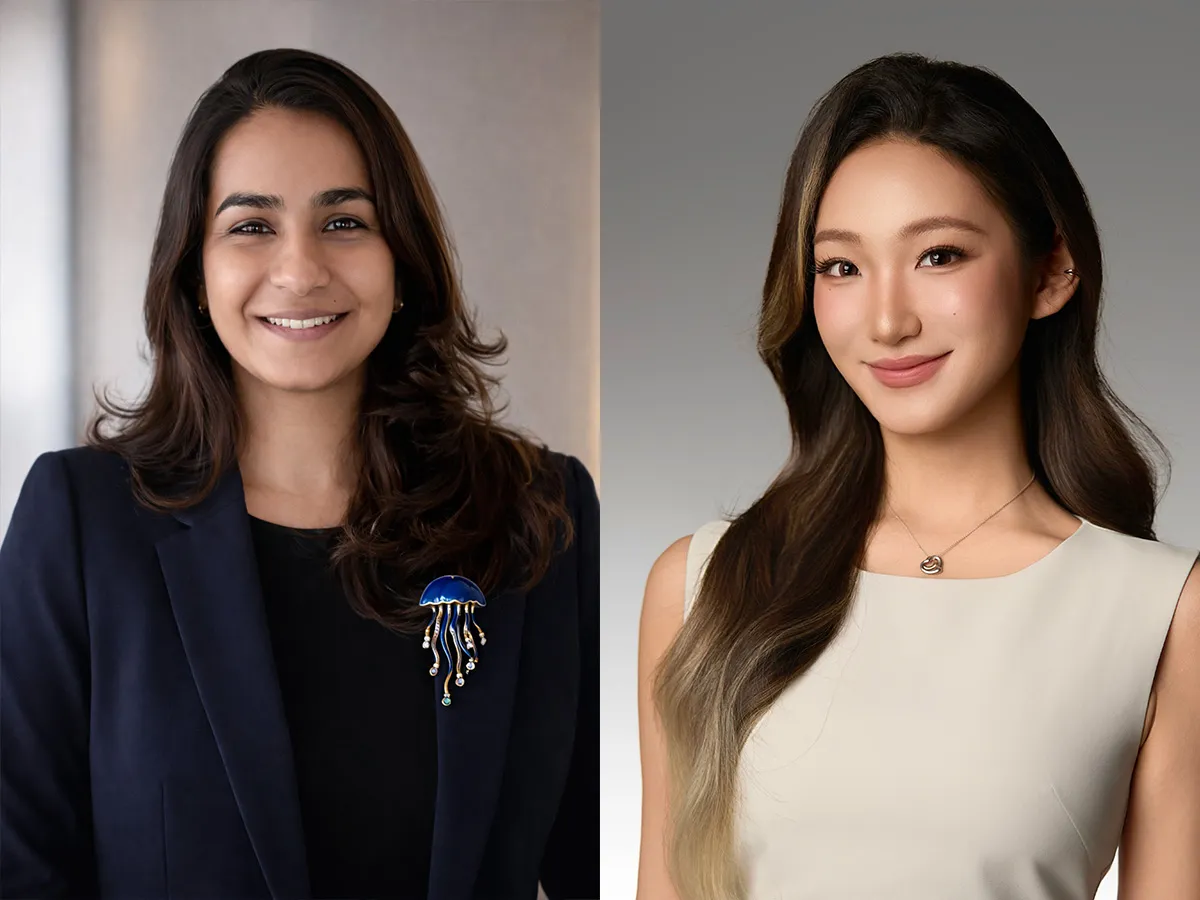
There’s something special about the people who end up behind the podium on graduation day. They’re the ones who have lived through the late nights, the classwork, the “how is this already due?” moments and still found a way to step back and make meaning of it all.
Ira Sharma (MBA ’26) and Danlin Yang (Finance ’26) have been there.
As this year’s student speakers, they’re capturing the excitement, challenges, and growth that have defined the experiences of the entire Class of 2026. From balancing careers and coursework, to building lasting connections and finding their voice as leaders, their journeys are just starting.
Before they take the stage, we caught up with Sharma and Yang to hear about their time at Carey, what they’ve learned along the way, and what comes next.
Ira Sharma (MBA'26)
Q: How was your overall experience in the MBA program? What skills have you gained and how has the program helped prepare you for your career?
A: My overall experience in the MBA program has been deeply transformative. Carey armed me with the business language, tools, and confidence to apply that thinking more intentionally. With a background in industrial design and parents who are both trained designers and serial entrepreneurs, I came to Carey already thinking in systems. Design thinking shaped the way I understand people, constraints, trade-offs, and finding the hidden possibilities.
Carey expanded that lens of design thinking to view companies as systems, the components of which are its people. It is made up of strategy, finance, operations, people, markets, incentives, culture, and execution. The MBA gave me a way to understand each of those pieces more intentionally, and to see how they connect.
Specializing in Health, Technology, and Innovation allowed me to explore the industries I care most about through a business lens. I also completed a graduate certificate in Financial Management to better understand the financial foundations behind business.
Learning about AI with Professor Tinglong Dai also reshaped the way I think about technology. Coming from a product and design background, I had always viewed technology through the lens of users and systems. Carey helped me understand how technology also transforms business models, incentives, operations, and entire industries.
Q: What are your top three highlights from your Carey experience?
A: The people: Carey brought me into a community of classmates from around the world, each with different lived experiences, ambitions, and ways of thinking. I found what I often think of as my personal advisory board of peers and incredible women. Some of the most meaningful learning happened outside the classroom, in conversations with peers who challenged how I saw leadership and impact.
Mentorship and support from faculty, staff, alumni, and Carey leaders: I deeply appreciated how accessible and invested Carey’s leadership was throughout the program. Dean Triantis’ open office hours were a meaningful example of that. It mattered to have a dean who made time for students, listened closely, and cared about our experience, not just at a distance, but in conversation with us.
The chance to build and lead within the Carey community: Through the Graduate Healthcare Business Association (GHBA), we set a new vision for the year and made a deliberate shift from what the club had previously focused on. Instead of centering our work around one large conference, we focused on creating smaller, consistent opportunities for engagement throughout the year and a community extending across Johns Hopkins schools.
We wanted GHBA to become an active home for students interested in the business of health, and to reach beyond Carey into the broader Johns Hopkins community. That experience taught me that leadership is about finding the right people to build with and creating systems that can continue beyond you.
Q: What are your career plans after graduation?
A: After graduation, I’m set to join Aisomer, being built by Dr. Abe Abraham, a Carey alumnus and member of the Dean’s Advisory Board, along with his co-founder Aji Abraham. Abe and I first met through a 15-minute coffee chat organized by the Full-time MBA team at Carey, which feels very full circle now. What started as a short introduction became one of the most meaningful mentorships of my time at Carey, and I am really excited to now have the chance to build alongside him and Aji.
Aisomer is building AI for the life sciences industry. I have worked with startups across different sizes and funding stages, but this will be my first time building from the ground up and having the chance to help shape direction from day one.
I’ve worked with startups across different sizes and funding stages, but this will be my first time building from the ground up and having the chance to help shape direction from day one. That is exactly the kind of learning I was hoping my next chapter would hold! I have always loved the pace and energy of startups, and the process of taking a vision that is still abstract and turning it into something real.
Long term, I want to be someone who builds and helps others build, whether that is through my own company some day or supporting others through investing.
Q: What is one piece of advice you would give an incoming student about Carey and/or the MBA program?
A: Come in with curiosity, but not with too rigid of a plan. You will come to Carey with your own way of seeing the world, and the MBA will give you new languages, tools, and frameworks to expand it.
Carey is a place where you can build your own path, but you have to participate actively in shaping it. Ask for that conversation, go to that event, and follow up with that incredible professor. Take the class that makes you curious, even if you do not yet know how it fits.
Some of the best opportunities will come from conversations you didn’t expect, classes you did not think would change you, and people who see something in you before you fully see it in yourself. My experience became a lot richer when I started treating it as a community to build.
Danlin Yang (Finance ’26)
Q: How was your overall experience in the finance program? What skills have you gained and how has the program helped prepare you for your career?
A: I had a really positive experience in the 15-month Finance program. I love how the curriculum balances fundamentals with forward-looking topics. We have courses on topics like investments, financial modeling, accounting, statistics, and econometrics, while also having electives like machine learning for finance, hedge fund, private equity, crypto, and AI applications. I studied finance during my undergraduate, but this program never felt repetitive. Instead, it helped me connect traditional finance knowledge with the direction the industry is heading. I also found it easy to pass the CFA exam during my time at Carey, as we covered core CFA content in the courses.
The pace of the program also pushed me to become more efficient with my time. With shorter, eight-week terms, you really learn how to prioritize, stay organized, and balance academics with recruiting and everything else going on.
Outside the classroom, Carey gave me many opportunities to explore different paths. I interned in investment banking and private equity in the U.S. and had many interview opportunities through the Handshake platform and school events. Networking events, guest speakers, and conversations with alumni really helped me better understand what I wanted to do long term.
And being in Washington, D.C. was definitely a big plus; I really enjoyed studying and living here. The location of the school is amazing. It’s hard to beat studying in the library while watching the sun set over the Capitol.
Q: What are your top three highlights from your Carey experience?
A: Personal and professional growth: I genuinely grew a lot during my time at Carey and feel much more confident now, both in my skills and how I think about my future. The program pushed me outside of my comfort zone, whether it was taking more quantitative courses or actively putting myself out there at networking events.
The people and community: I met some great friends here, and I also connected with people I could see myself working with in the future, whether through group projects or alumni interactions.
School events: Both Carey locations in Washington, D.C. and Baltimore gave us access to a broader range of resources. For example, I was able to attend career fairs in both locations. I also really enjoyed the Finance Discussion Group led by Professor Kwang Soo Cheong, where we discussed current topics in finance and heard different perspectives from schoolmates.
Q: What are your career plans after graduation?
A: After graduation, I’ll be going into investment banking. I explored roles in private equity, banking, and advisory, and found investment banking to be the best fit for me.
Q: What is one piece of advice you would give an incoming student about Carey and/or the finance program?
A: Be confident in yourself and the program. Stay open to trying new things and exploring different paths. Give yourself time and chance, don’t feel like you need to have everything figured out from the start. Take full advantage of everything around you because there are so many resources, from classes and professors to career support, events, and the people you meet. The more you put yourself out there, the more you’ll get out of the experience. Carey’s faculty is also incredibly supportive, so don’t hesitate to reach out.