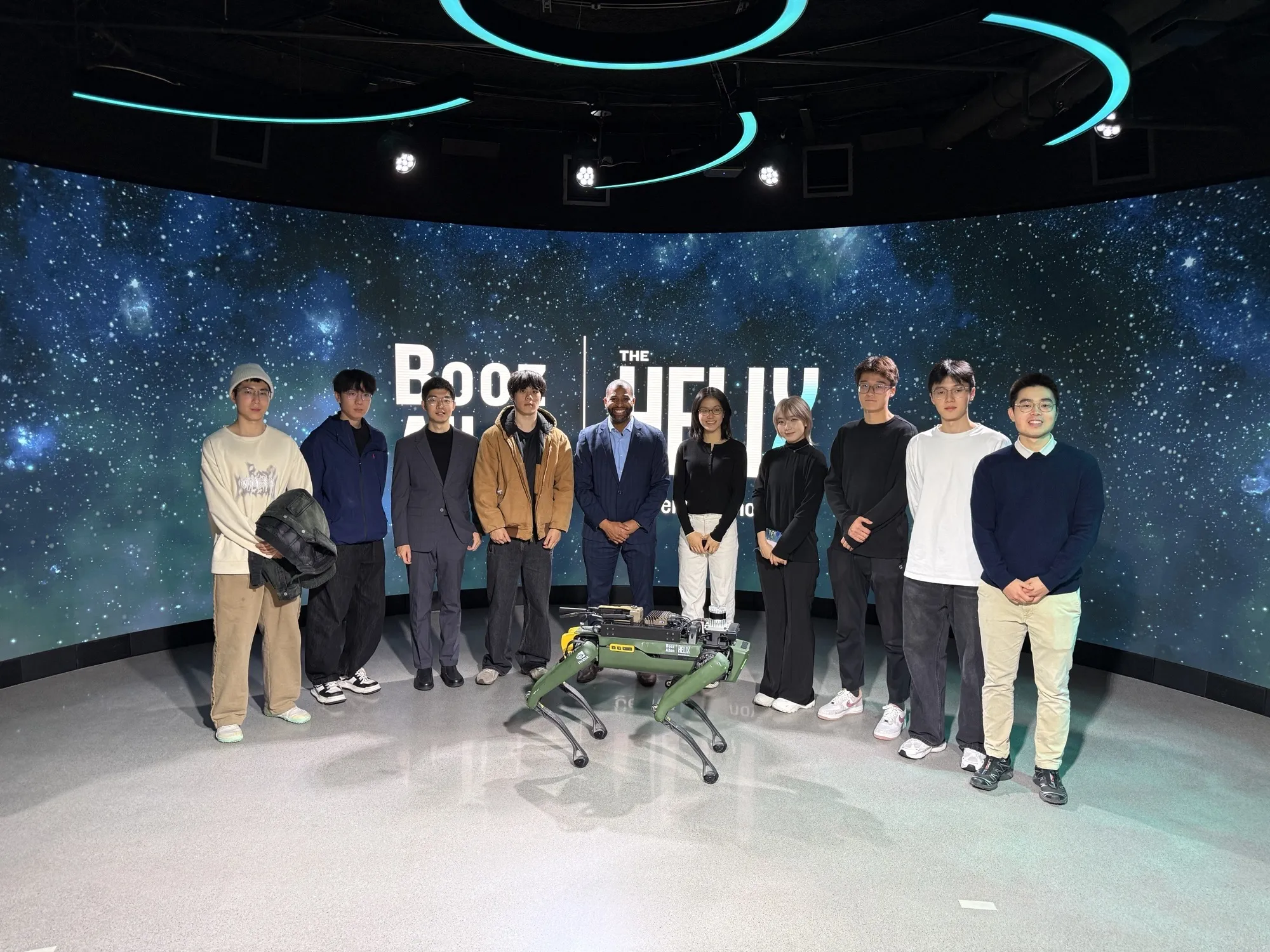
The Helix, Booz Allen’s Center for Innovation is a 9,400-square-foot flagship in downtown Washington, D.C., that most people never get to see. It’s an invitation-only experience typically reserved for government clients and high-level partners.
But students from Carey’s Information Systems and Artificial Intelligence for Business program were lucky enough to get the golden ticket.
Booz Allen is an advanced technology company delivering outcomes with speed for America's most critical defense, civil, and national security priorities. They build technology solutions using AI, cyber, and other cutting-edge technologies to advance and protect the nation and its citizens.
The Helix houses over 300 simulations, hands-on activations, and live demonstrations spanning artificial intelligence, cybersecurity, quantum computing, 5G, and edge computing. It is, in short, one of the most concentrated showcases of emerging technology in the country.
The visit came from conversations between Carey and Director of Space Cyber Missions at Booz Allen, Eric Jones, who is an alumnus of the Information Systems program and on Carey’s Dean’s Alumni Advisory Board.
“It's a great example of the strength of our alumni network and graduates continuing to open doors for the next cohort. We’re very grateful to Eric for organizing the visit and creating such a meaningful experience,” said Academic Program Director and Professor Changmi Jung.
This rare, behind-the-scenes look showed students how Booz Allen brings these technologies to life in service of real-world missions in defense, national security, healthcare, and climate resilience.
“I wanted our students to see firsthand what the No. 1 provider of AI services to the U.S. government is working on – and how,” said Jung. “Beyond the technology itself, I wanted them to leave with a clearer picture of how mission-critical AI gets scoped, built, and deployed in the real world.”
While classroom learning gives students the foundation to understand how AI is used, these types of visits show exactly how those ideas are deployed in real life.
“Hearing directly from professionals and seeing real-world applications makes it easier to connect what we learn in class to actual business challenges and career opportunities,” said ISAI student Minying Zhou. “As a student, it also helps me better understand what skills employers are looking for and how different roles contribute to AI-related projects.”
Students were immersed in The Helix's environment of live demonstrations and hands-on activations, including walkthroughs of Booz Allen's work in AI, cybersecurity, space, and edge computing. The visit included conversations with Booz Allen project leads and technologists about how the firm approaches large-scale AI projects, from research through deployment.
“What impressed me most was the maturity and intentionality behind many of the students’ questions,” said Jones. “They were not simply focused on how to build technology but focused on how to steward it responsibly. Several students wanted to understand how organizations can innovate aggressively while still protecting people, preserving transparency, and maintaining mission integrity. Others asked how leaders can remain adaptive when industries are changing faster than traditional institutions can sometimes respond. Those are not surface-level career questions; those are questions from individuals already thinking like future executives, policymakers, founders, and change agents.”
The ISAI program is built around how AI is designed, applied, and implemented across different domains, with strong emphasis on AI management and governance alongside the technical foundations. The curriculum prepares students to think rigorously about how AI projects are scoped, led, and overseen, and how they ultimately affect the people they're meant to serve, not just the organizations deploying them.
The Helix gave those frameworks a concrete home.
“Before visiting The Helix, most of my understanding of AI came from classes, articles, and online discussions,” said Zhou. “Seeing in-person examples made everything feel much more concrete. What impressed me most was how widely AI can be applied. AI is being used to help organize and process medical records, as well as simulate technologies used in motorsports. AI is not just a technology trend; it is being used to solve practical problems in very different fields. The visit helped me better understand what people mean when they talk about AI-powered advantages across industries.”
Jung says the visit brought classroom concepts to life. Students saw multi-stakeholder AI initiatives in action, the breadth of mission areas where AI is having real impact, and the governance and adoption considerations that determine whether those projects actually deliver value.
“It reinforced what we emphasize in the program: that AI's value is measured by the impact it creates for humanity,” said Jung.
What’s next for ISAI students
The kinds of systems students encountered at The Helix, like autonomous platforms, AI-powered federal health tools, edge computing deployments, and digital twins, are exactly the kinds of systems our ISAI graduates go on to build and manage at companies like Booz Allen, Accenture, Deloitte, Lockheed Martin, Meta, and more.
“When students walk into a place like The Helix, they are not just visiting an office. They are seeing what possibility looks like in motion. They begin to understand that the theories, discussions, and ambitions developed at Carey can translate into tangible leadership, innovation, and impact in the world,” said Jones.
Jung and Jones both expressed that they hope this exposure will inspire students to think bigger about the kinds of problems they can tackle in their own careers.
“When students encounter alumni who are actively leading in industry, academia, government, or innovation, they are not simply networking. They are gaining permission to imagine larger possibilities for their own lives,” said Jones. “Exposure expands vision. Representation expands belief. Sometimes students do not need another lecture as much as they need to physically see what is possible for someone who may have started from circumstances similar to their own.”
Johns Hopkins Carey Business School’s Information Systems and Artificial Intelligence for Business program prepares students to design, apply, and lead AI initiatives across industries. To learn more about the program, visit the Information Systems and Artificial Intelligence page.