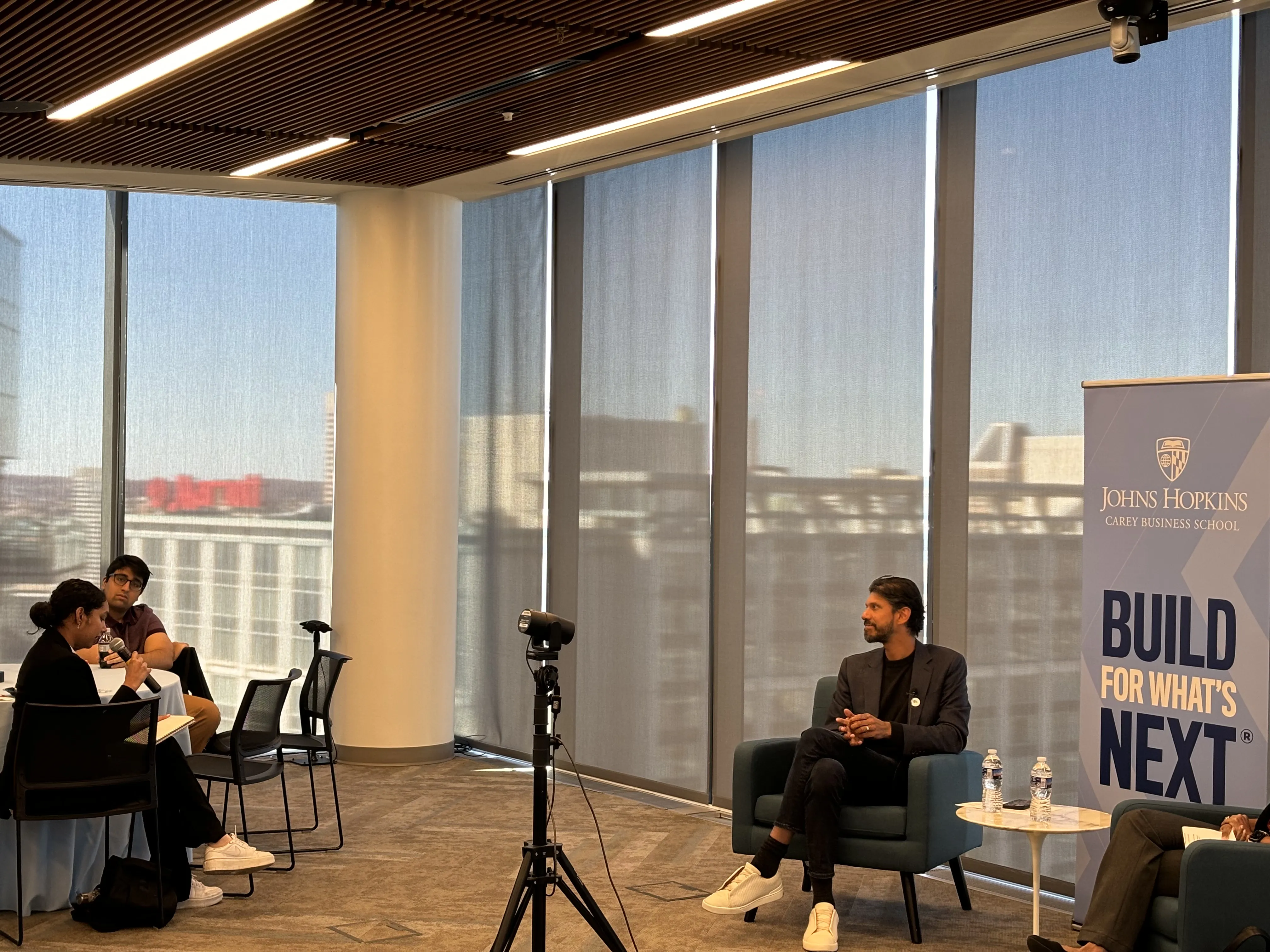
Now in its second year, the Conversations in Health Care Management series at Johns Hopkins Carey Business School brings together leading voices in health care to share insights on innovation, leadership, and the future of the industry.
This month’s conversation featured Arun Krishna, vice president and head of the Lung Cancer Franchise, U.S. Oncology Business Unit at AstraZeneca in a discussion moderated by Carey’s Associate Dean for Academic Programs, Dr. Supriya Munshaw. Krishna shared his perspective on oncology innovation, the evolving life sciences landscape, and career pathways for new graduates and early-career professionals eager to make a difference.
Krishna oversees the U.S. commercialization of leading lung cancer therapies, including TAGRISSO and DATROWAY, leveraging his extensive experience in oncology strategy, market access, and cross-functional leadership.
Reflecting on his career journey, Krishna emphasized the importance of finding purpose early and letting it guide one’s impact, saying, the sooner you find your purpose, the sooner you can create change for yourself.
During the conversation, Krishna talked about the science driving breakthroughs in lung cancer, the power of collaboration across large organizations, and how strategic leadership can transform patient outcomes.
Full-time MBA student Anajulia Almonte said Krishna’s remarks deeply resonated with her.
“His insights on strategy, leadership evolution, and innovation in oncology offered a rare perspective on how scientific expertise can translate into commercial impact,” she said. “I was especially moved by his reminder that ‘everyone says they are strategic, but few do the work to be strategists.’ I am grateful that Carey curates such authentic and thought-provoking conversations that connect science, business, and purpose.”
The conversation explored topics ranging from AI's potential in drug development to ensuring patient access and affordability, and how to make high-stakes decisions with limited data. They also discussed the evolution of oncology innovation, why cross-functional teamwork matters as much as scientific innovation, and how to explore career pathways that make an impact.
Krishna highlighted the wide range of career opportunities available at AstraZeneca, including roles in research and development and market access, and spoke on the rapid pace of innovation, such as the integration of AI across these functions.
He encouraged students to take risks, stay curious, and continually develop their strengths.
“The next generation is eager to contribute and transform health care at such a pivotal moment in time,” said Krishna in a LinkedIn post. “They’re prioritizing patients, evidence, and outcomes in a world that’s quickly shifting, thanks to AI, technology, and scientific discovery. I can’t wait to see how they’ll push the boundaries of science as the health care leaders of tomorrow.”
Visit Carey’s Conversations in Health Care Management webpage to learn more about the upcoming speakers.