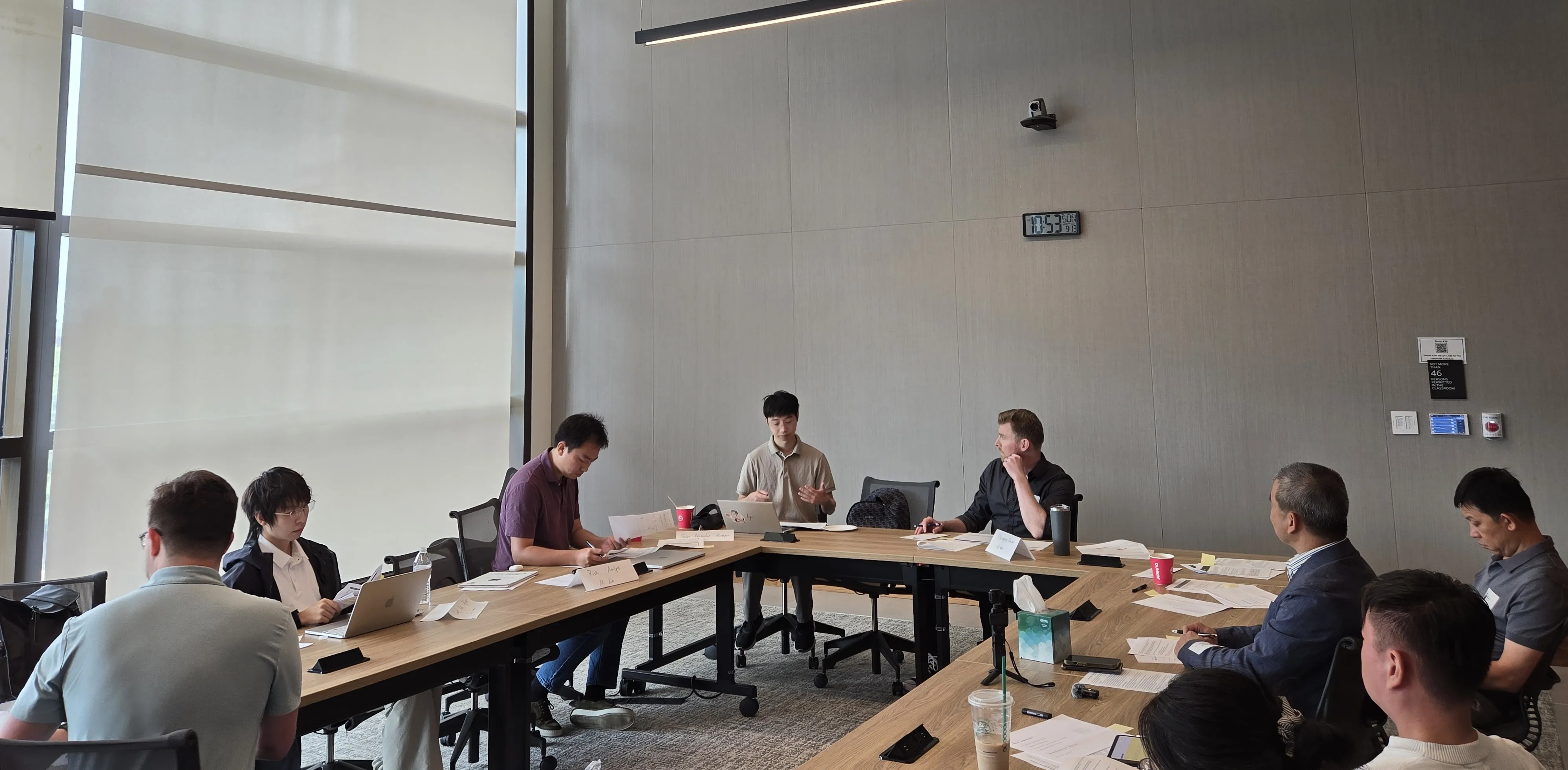
Carey’s Information Systems and Artificial Intelligence for Business students recently participated in STAGE, an immersive leadership and communication exercise held at the Johns Hopkins University Bloomberg Center.
Built around the idea that “leadership isn’t taught, it’s rehearsed,” the full-day program invited students to practice responding to ambiguity, interpersonal tension, and high-stakes decisions in a realistic business setting. Rather than studying leadership through a lecture or written case, the students became part of the case themselves.
The Information Systems and Artificial Intelligence program builds expertise in AI ethics, governance, and applications. With little to no coding experience required, our students develop technical skills while building their leadership expertise in hands-on projects, like the STAGE event.
Stepping into the scenario
Before the event, each student was asked to complete a short survey. Based on the responses, the students were assigned distinct roles in Silent Genius, a simulated closed-door meeting involving a $50 million loan decision. Each student received information about their character, responsibilities, and professional relationships, but no one had the complete picture.
That information gap was central to the experience.
Just as in real organizations, the students had to determine what they knew, what others might know, and what information was still missing. They also had to consider when to speak, when to listen, when to ask questions, and when it was necessary to challenge or interrupt someone.
The students first completed the scenario with limited guidance, allowing their instinctive communication and leadership styles to emerge. A subsequent round was recorded for detailed review.
Seeing leadership in action
During the video-review session, the students and facilitators paused the recording at key moments to examine not only what was said but how it was delivered. Coaching addressed speech, tone, confidence, listening, body language, and the dynamics among the different characters.
Even small choices became meaningful learning opportunities.
“We practiced the small things that are easy to overlook, like how to give a proper handshake, how to introduce a teammate to a senior person, and how to carry yourself when you walk into a room,” said current student Weixuan Zhang.
Students examined how crossed arms, hands placed near the mouth, voice pitch, and overly long explanations could affect how others interpreted their messages. They also practiced replacing uncertain or defensive responses with language that was both honest and composed.
The exercise also challenged participants to respond strategically when they encountered unexpected information.
These adjustments were not about memorizing the “right” sentences. It encouraged them to understand the intention behind their communication and choose language appropriate to the audience, relationship, and business objective.
Looking beyond individual performance
Exploring six questions designed to help analyze their characters’ hidden missions and broader goals, the discussion moved beyond completing the immediate task to examining organizational relationships, competing interests, and the consequences of each participant’s choices.
Who needed to be persuaded? Who possessed essential information? When should a participant be more assertive? How could someone manage expectations by under-promising and over-delivering?
The students also reflected on teamwork. Phrases like, “Since I completed this analysis” may unintentionally suggest individual ownership rather than a shared team effort. In a high-pressure setting, these subtle signals can influence trust and collaboration.
This part of the program was highly interactive. The students asked questions about their characters, the relationships in the room, and the information available to each role.
They then applied the feedback in a final recorded performance.
From feedback to visible improvement
Following the final performance, evaluators assessed the participants across several leadership and communication dimensions. Before seeing the results, the students were asked to identify the areas in which they believed they had improved most, including confidence, communication, and listening.
Many of their own assessments closely matched the evaluators’ conclusions.
“I improved my ability to understand and listen, and how to communicate better with different personalities,” said current student Yugi Guo.
That alignment demonstrated one of the most valuable outcomes of the experience: greater self-awareness. By rehearsing, reviewing, receiving coaching, and trying again, the students learned to recognize their own patterns and make intentional changes in real time.
For Information Systems and Artificial Intelligence students preparing to work at the intersection of technology, data, and organizational decision-making, these human skills are essential. Technical knowledge can produce an excellent analysis, but professionals must also know how to communicate that analysis, establish credibility, navigate complex relationships, and help a team move toward a decision.
STAGE provided a safe environment where business stakes were simulated, but the learning was real. The inaugural experience was one of the program’s most engaging student activities, and a powerful example of how Carey prepares students not simply to understand leadership, but to practice it.
“My biggest takeaway was seeing how a real workplace actually operates,” said current student Liwei Jia. “In particular, I learned how each person in a meeting should voice their opinion. Not just what to say, but how and when to say it. And I got to see how a critical business decision actually gets made inside a real company. I found that eye-opening, and it has given me a great deal to think about going forward. Experiences like this are really important for students like us.”